Ancient Wisdom, Artificial Minds
Recap of DELTA at Hard Fork Live in San Francisco

This past week the DELTA Force traveled to San Francisco for Hard Fork Live, the second annual live taping of one of our favorite podcasts. For the uninitiated, you might think this is a podcast analyzing heavy gauge flatware. But in the tech world, a “hard fork” is a radical and irreversible divergence in a piece of software. Every week, Kevin Roose and Casey Newton discuss current trends in technology that are forcing us into societal hard forks.
I love the podcast because, while it is hilarious, Kevin and Casey also fearlessly take on difficult ethical issues. Last summer they grilled the CEO of Roblox on whether his platform adequately protects children. They thoughtfully break down the risks of nationalizing powerful AI models and what is at stake when tech companies disagree with the government on security. Each weekly episode focuses on the stakes of these decisions for our ways of life.
So we were thrilled for the DELTA Network to be a sponsor of this year’s live taping, which included Microsoft CEO Satya Nadella answering questions about the economics of enterprise AI alongside a dancing (sometimes fainting) robot and Cindy Cohn, one of the country’s foremost experts on privacy. Needless to say, we were up way past our bedtimes!
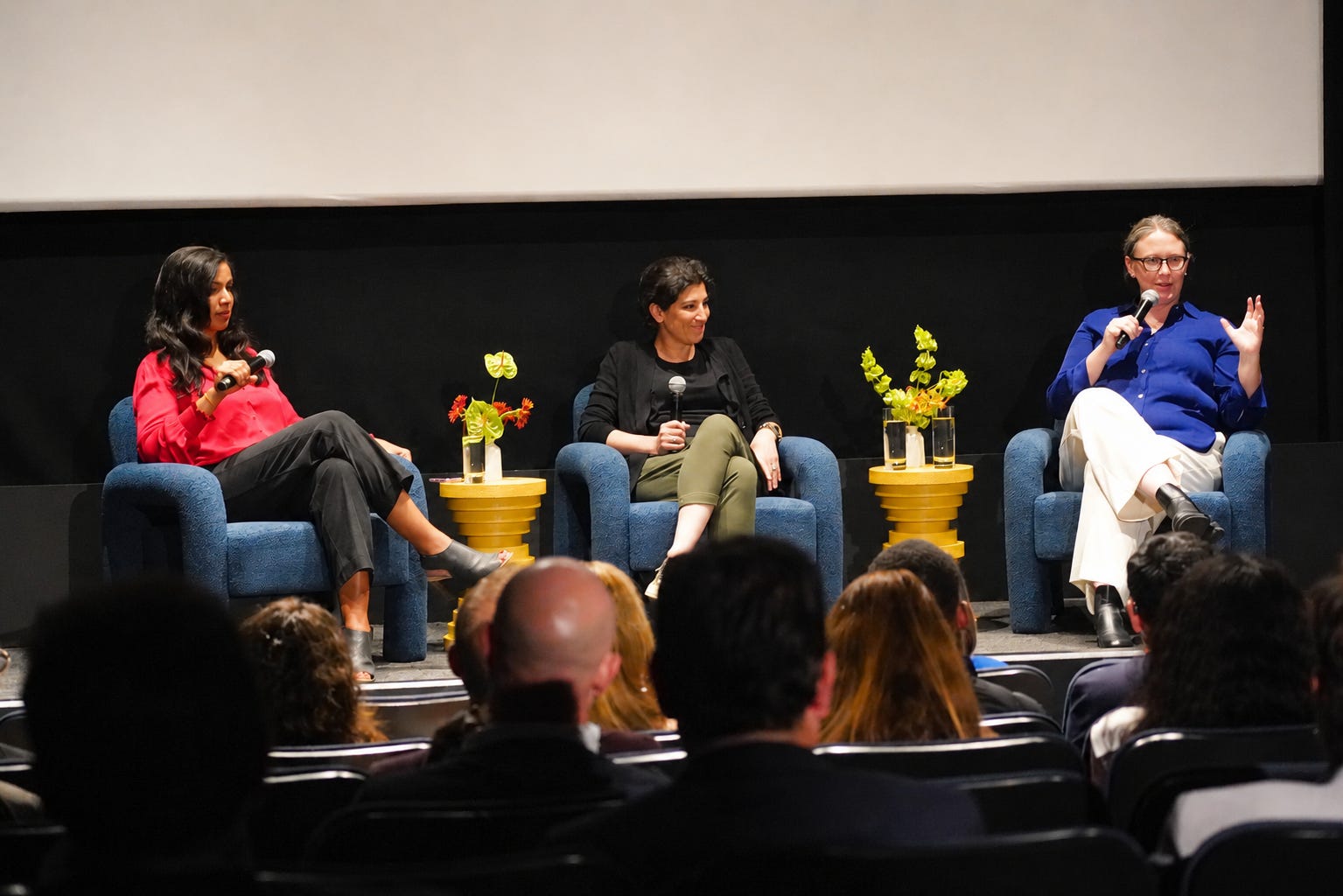
We had the opportunity to lead the opening act for HFL, a wonderful panel we called “Ancient Wisdom, Artificial Minds.” Journalist Aarti Shahani interviewed me and Georgetown tech scholar Renee DiResta on the significance of the new encyclical, what Plato would make of Meta’s leadership, and whether morality has a fighting chance in our supercharged tech world. You can check out the whole video on the New York Times’ site.
We also had the chance to visit with colleagues working at some of the frontier labs on this trip and to reconnect with school leaders who got the first round of DELTA Rapid Response grants. I left Hard Fork all the more convinced that we need more folks to roll up their sleeves and do the gritty work of translating between faith communities, tech developers, educators, and average tech users. And I was so heartened by the appetite in Silicon Valley right now for the big, old insights from virtue ethics. Maybe the field of technology ethics is at a hard fork, having spent the last few decades dominated by a weak kind of utilitarianism? I left newly aware that this system is breaking down and the world is ready to rebuild this field with a more durable foundation.
Speaking of the deep magic, I am headed to the Vatican this week to spend time in the source code, but there’s lots of posts to come as we get into our summer rhythm here. We’re gearing up for our grad seminar on the Claude Constitution and working with schools, dioceses, and church communities across the country on community-level DELTA projects. I’ll be out at the Aspen Ideas Festival in a few weeks debating Paul Bloom, David Brooks and Mitch Landrieu on whether we should try to love strangers. You know where I stand…
PS: Check out the NYT’s Future of Work print edition this weekend. We have a half-page ad celebrating Pope Leo’s call to respect the dignity of workers: “When efficiency becomes the ultimate measure of value, human beings are tempted to see themselves as a project to be optimized weather than as persons called to relationship and communion.”