From Bell to Bell: Reflections on a Cross-Country Listening Tour with High School Educators and Students
Reflections from Institute for Ethics and the Common Good team members Clare Cullinan, research associate, and Michael Downs, DELTA Bay Area program director for regional engagement.
Before the back-to-school bells rang, team DELTA hit the road to consult with high school leaders and educators about AI. The bell turned out to be a fitting metaphor for our diverse and dynamic encounters — from the Bell Chapel at Marist School in Atlanta, to the bells of Bellarmine College Prep in San Jose. Now faced with new reporting on the many potential risks of AI for students’ cognitive development and overall learning outcomes, we feel inspired to share what still resonates (at the risk of overusing the analogy — more cowbell, please!) — from our sojourn with so many folks wrestling with how to preserve the dignity of learning (DELTA director Adam Kronk also dropped some knowledge on this topic this summer).
From Saturday Night Live’s comedy sketch, “More Cowbell”.
Delightful Days in Atlanta with Marist
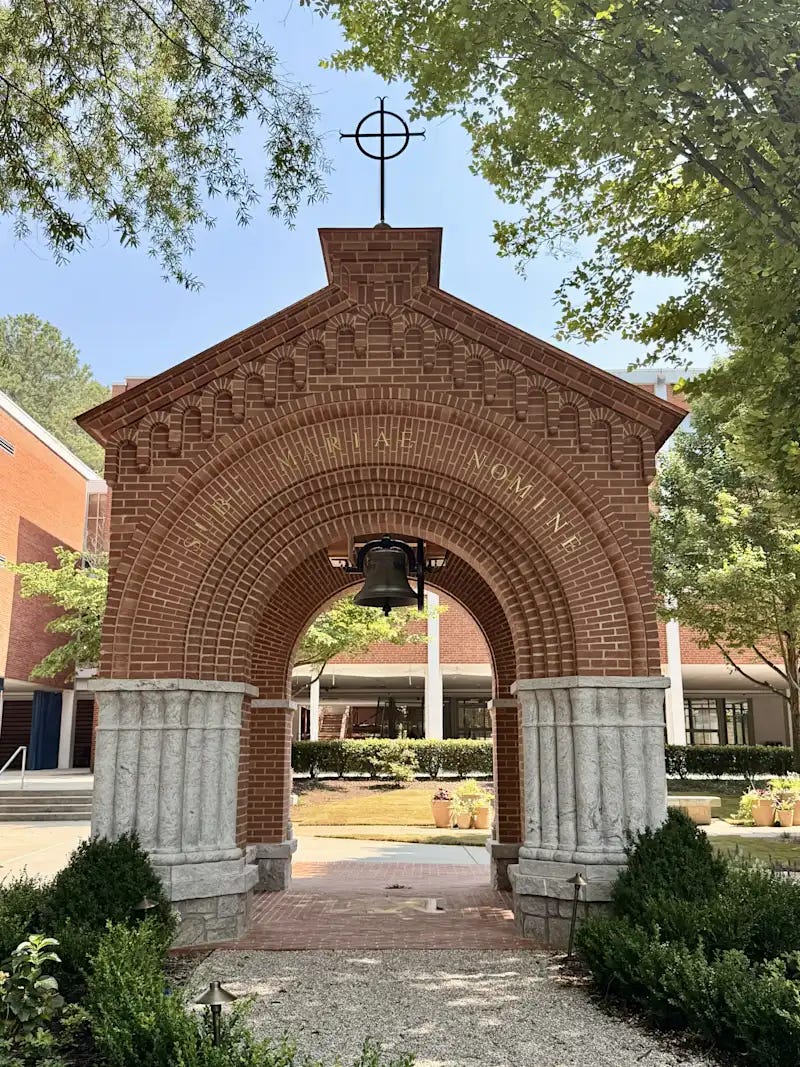
In the spirit of listening, Michael and I (Clare) arrived at Marist School in Atlanta to attend the Humans First: Adolescent Education in the Age of AI Conference — a gathering of mostly middle and high school educators to explore big questions around AI use in schools and how to keep human dignity at the center (sounds right up the DELTA alley, doesn’t it?!). Walking across Marist’s campus, the sounds of outdoor band and football practice reverberated as I passed Marist’s Bell Chapel. Formerly known as the Mission Bell, students would ring it when they prepared to return home from retreats, bringing all they had learned back to the Marist community. Inscribed on the arch of the chapel above the bell is the phrase, “Sub Mariae Nomine,” meaning “Under the Name of Mary,” meant to inspire students to go forth and “be Marist” in the world.
Marist’s Bell Chapel
Fittingly, the conference opened with a panel of Marist students who spoke about how their experience living through the age of AI has made them reconsider their sense of purpose. One panelist shared how she sees high school education shifting, explaining that grades, prestige, and resumes are prioritized over her actual learning experience. She even took it one step further, observing that the rise of AI initially led her to lose confidence in her own writing and creativity, but that she has now stepped back and restored a sense of trust in herself.
These students set the tone for the following presentations and panel discussions from a variety of experts and educators. There was so much wisdom to digest, but three big insights stood out.
The purpose of education is human formation.
The work of human formation makes me think of the church bell, which brings a congregation together and signals the beginning of a ritual that repeatedly shapes a person. The growing understanding of schools as simply credentialing systems can result in a cacophony of unhealthy competition and a push to keep up with the fast pace. I kept hearing the teachers’ plea to “slow down,” by placing “human dignity before efficiency and formation before convenience.” Education, at its core, is meant to form students who seek the truth, recognize the dignity of all, and serve the common good.
One of my favorite parts of the conference and a fascinating example of human formation in action was the student-led podcast series (sponsored by one of our DELTA rapid response grants!) that was recorded while we were there. Led by recent Marist grads and current students, and produced by social studies teacher Nic Hoffmann, this podcast gave attendees the opportunity to grapple with what it means to be human in the age of AI. Check out the podcast series (released here every Thursday) to listen firsthand!
The role of the educator is integral.
What better bell is there to represent the teacher than the school bell that rings at the start and end of each class, signaling that it’s time for the teacher to call the class together. This consistent reminder is essential to the function of the school day and keeps the rhythm of the schedule calm for everyone. (Fun fact: my high school tried experimenting with getting rid of the bells one year — it epically failed, and much stress ensued).
Educators are sort of like the school bell: they’re integral to the intellectual, moral, social, and spiritual development of students. The educators I spoke with share a belief in the “sacred responsibility” of teachers to serve and shape their students. There was a strong spiritual undercurrent and emphasis on Mary, Marist’s patroness. A question we kept returning to was: how are educators called to be like Mary for youth in the age of AI? Is it like protectors, as Mary protects Jesus?
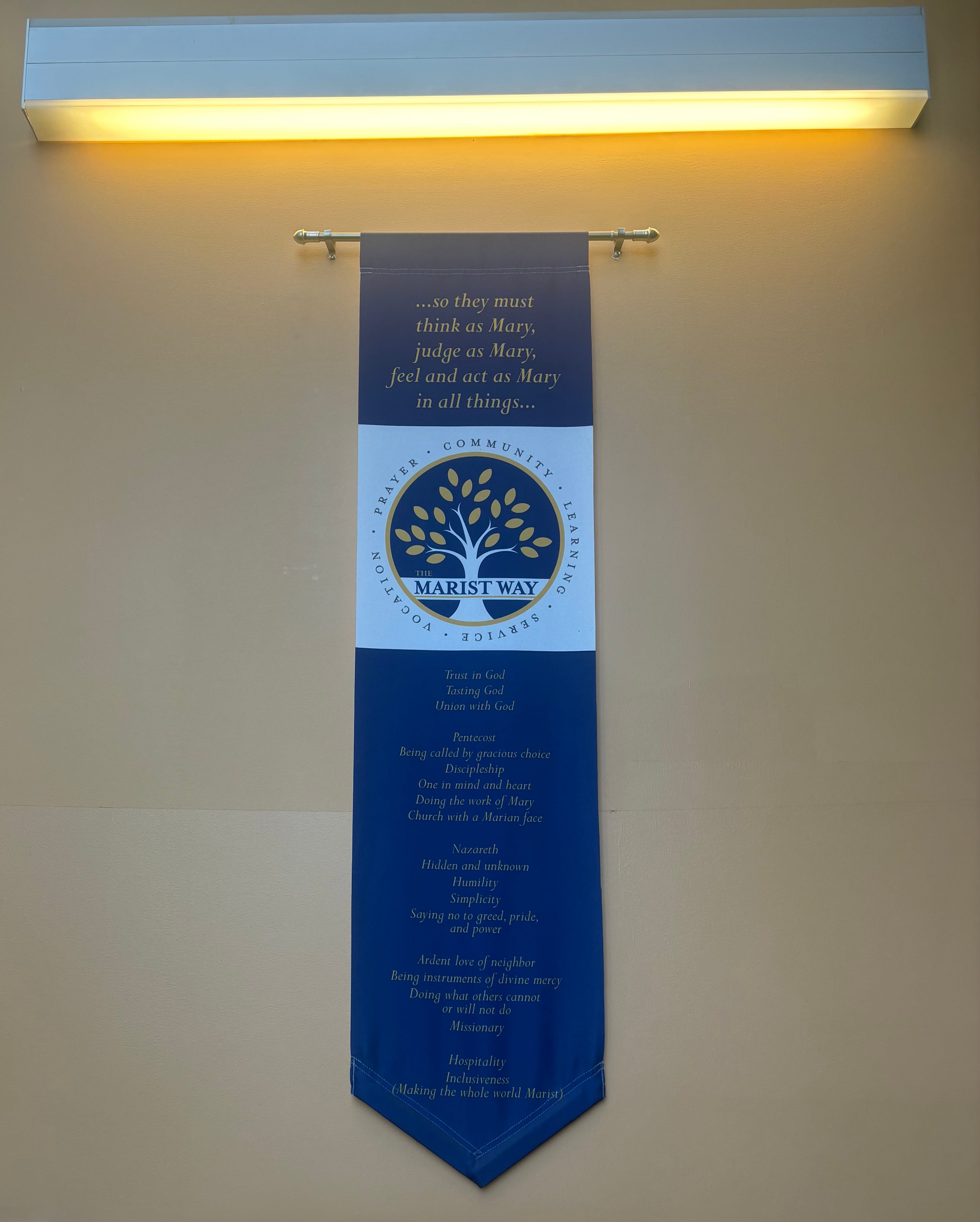
The banners that hung in the hallways said: “...so they must think as Mary, judge as Mary, feel and act as Mary in all things…” Could the vocation of educators be to emulate Mary for their students?
The Marist Way banner
The work of education must be done in community.
Coming together as a community brings to mind the image of a handbell choir, where each individual bell is rung by a single person, but when played together creates a chorus of sound. It has always been incredibly important, and even more so now, that we gather in person to have conversations. The Humans First conference is a true testament to why this matters, and brought together over 100 educators from 44 institutions and 21 states, ranging from tech-heavy Silicon Valley to the heart of the South.
Marist fostered community among conference attendees through “homerooms” – designated small groups that met multiple times each day to discuss conference themes in greater depth and ask questions. These embodied conversations with other educators were enlightening. There was one teacher who shared that she was shocked to find out that, unbeknownst to her, she had been carefully packaging and selling books to Anthropic’s Project Panama (a project buying up books to build out Claude’s knowledge base). Here she was trying to preserve rare physical books, and lo and behold it was all being fed to an LLM. This led to an interesting discussion in our homeroom about the value of a physical book and its purpose in the increasingly digitized classroom.
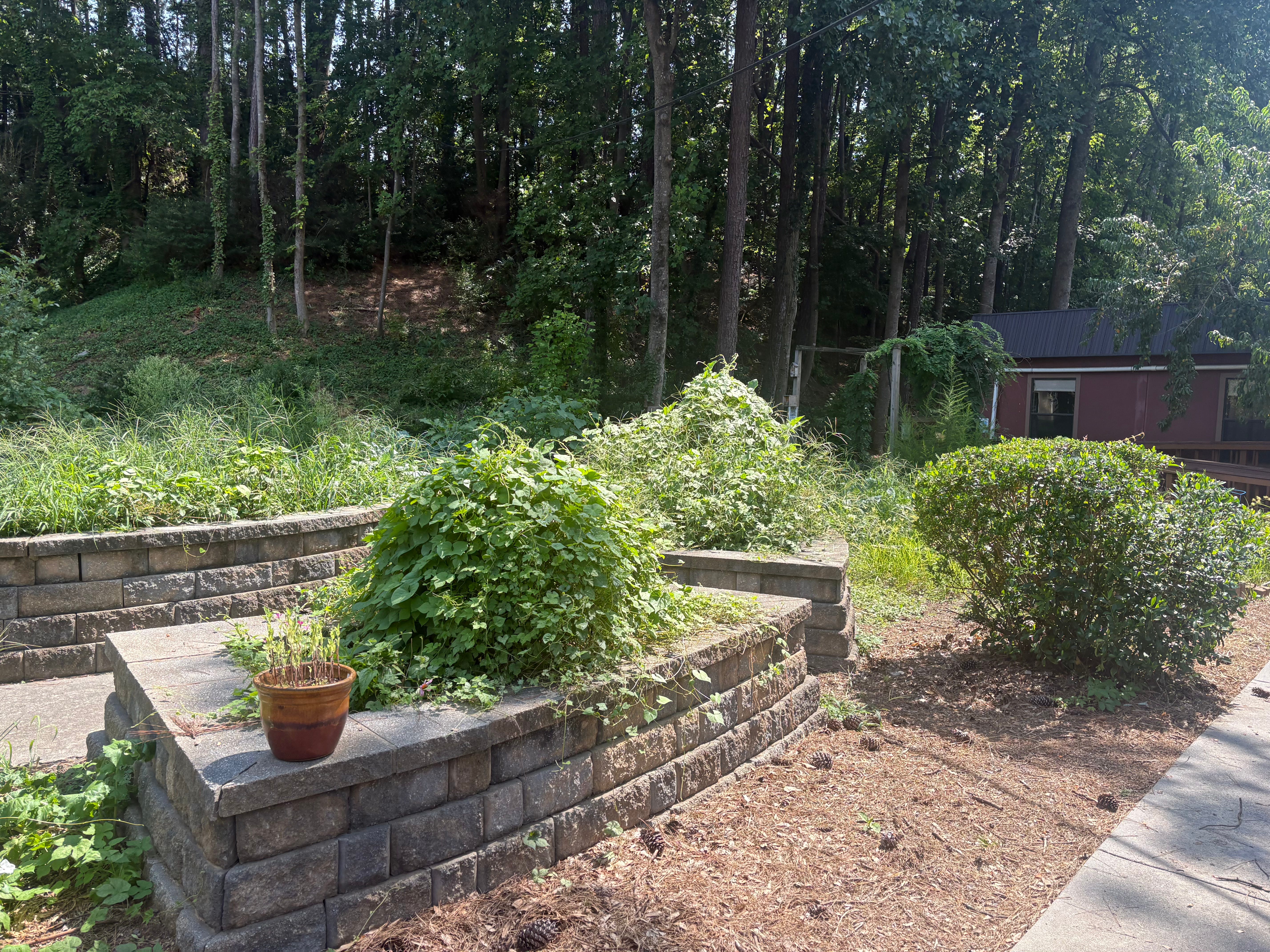
Kevin Mullally, Marist principal and executive vice president, shared that “the choice isn’t just digital or analog. The choice is also monologue or dialogue.” At dinner with a group of Catholic educators, Kevin filled us with wonderful conversation and fed us what felt like bottomless tapas. Alex Thackston, conference coordinator and organizer extraordinaire, worked diligently to ensure that everything ran smoothly and that we were well-nourished throughout. On the last day, Mike Burns, master Marist teacher and creator of Humans First, asked if I’d like to pick some fresh peaches and figs from the Marist community garden, a perfect capstone to the conference. As we ran up the hill from the Bell Chapel to the garden, I couldn’t help but feel grateful for the community that Marist had created in only a matter of days.
Marist community garden
We were so grateful to welcome Kevin and Mike, along with some Marist students, to the DELTA Summit on AI, Faith, and Human Flourishing last week. More to come on the Summit!
With Bellarmine in the Bay
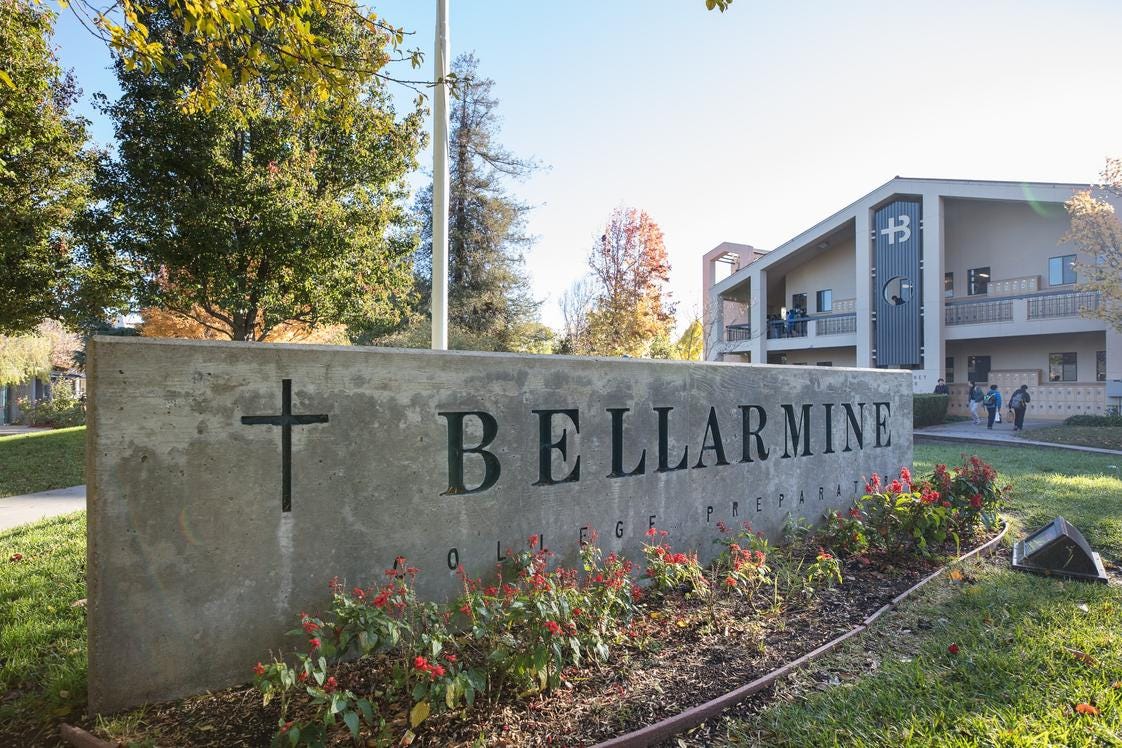
From the heart of the South to the heart of Silicon Valley, I (Michael) was invited back to a place I spent a decade teaching ethics and social justice: Bellarmine College Preparatory, an all-boys high school named after the Jesuit saint and cardinal, St. Robert Bellarmine. The seemingly benign mascot — “Go Bells!” — has rung out for countless academic and athletic victories since the school was founded in 1851. Originally named Santa Clara College Preparatory, Bellarmine is situated just down the road from California’s oldest college, Santa Clara University, whose Markkula Center is currently on the leading edge of applied AI ethics and a collaborator with DELTA. On this stop, I ended up speaking to the entire faculty and staff on the feast day of Santa Clara, the patron saint of another disruptive but important technology, television.
Bellarmine College Preparatory sign
Bellarmine is a school already reflecting on the DELTA principles across its curriculum and campus, after attending a DELTA intensive retreat with eleven other Bay Area high schools in late May. This community of practice has been lovingly titled our “DELTA Dirty Dozen.”
For the 1,600 boys who study at Bellarmine, the AI revolution is not an abstraction. It’s the lived reality of their family and friends, the story of their skyline. But even near the “belly of the beast,” teachers are grappling with if, how, and when to use AI.
During an opening exercise entitled “take a stand,” participants positioned themselves on continuums across various provocative AI spectra. For example, “When it comes to AI in education, are you more of a ‘Doomer’ (pessimist) or ‘Boomer’ (optimist)?” Suffice it to say there was more concern than confidence in this room of thoughtful practitioners teaching the children of tech company employees.
In the embodied experiences and discussions that unfolded, I was inspired by what I was hearing from their school leaders, including the following three insights.
We have to be a Jesuit school for what’s coming, not for what was.
To start each of my classes during my teaching days at Bellarmine, a mindfulness bell called us into the present moment, drawing us out of dwelling on past perceptions or future fears that don’t serve us.
A concept grounded in the gospels, renewed at Vatican II, and featured in Magnifica Humanitas, is “responding to the signs of the times.” These folks living so near to the biggest frontier AI labs recognize that they cannot bury their heads in the sand or the past. There is a uniquely Ignatian motto on the walls of Bellarmine that felt apropos: Age quod agis. That is, Do what you are doing. In a modern context, it translates to “be fully present in the moment,” or “focus entirely on the task at hand.” Rather than just an instruction to avoid distractions — of which there are plenty facing today’s adolescents and educators — it’s a call to put one’s whole mind, heart, and energy into what you’re doing, no matter how small or mundane the task may seem. It’s not a call to productivity, but to presence.
When it comes to AI, there have been moments when it felt like we were moving too quickly for some members of our community, far too slowly for others, and too fast and too slow at the same time.
This collective confusion reminds me of the alarm bell waking students (and teachers!), calling them out of bed and into school mode. Are we jolted into a rush-out-the-door mentality, or are we hitting the snooze button, pulling the covers up, and hoping it will all pass?
Two concurrent (but conflicting?) fears seem common among educators I met: (a) the fear of being “left behind” if they don’t adopt/integrate AI fast enough and (b) the fear of the what’s at stake for the dignity of teaching and learning, cognitive and creative abilities, the fate of humanities (and humanity), etc. Here at Bellarmine, this community is doing the hard work of discerning between these competing fears, and articulating an ambitious but admirable goal: not to be the first school to adopt AI, nor the last to resist it. The goal has been to become a school that responds wisely. “Schools are not called to follow the pace of the digital world,” emphasizes Pope Leo XIV in Magnifica Humanitas, “but to offer that which the digital sphere by itself cannot provide, namely a shared time for learning and developing trustworthy relationships.”
How do we faithfully carry our mission forward in a changing world?
A bell that starts a boxing round calls those in the ring to stand up, find our bearings, and stay in the fight, even if we feel beaten down and defeated. Many institutions right now, and in particular religious ones, are grappling with how to draw from the strength of a sometimes centuries-old mission in the face of an unprecedented technological paradigm shift. What aspects of our institutional mission hold up or hold us up? How does our mission call us, individually and collectively, to be and act in the age of powerful AI? The mission of this particular school, grounded in the broad and bold Ignatian mission, calls for a community “gathered together by God for the purpose of educating students to seek justice and truth.”
One of their leaders, who will join DELTA at the Ignatian AI conference at Fordham this week, emphasizes that though AI is the new frontier, the mission is the same: “Our north star has not changed. We are trying to form men who navigate with wisdom, lead with integrity, and serve with purpose.”
Each of the bells we encounter seem to be heralding this unique moment in time, ringing out as if to say: “This is the hour!”
Back home on Notre Dame’s campus, the Basilica bell rings every hour both as a reminder of both the time and a call to be present. As we learned on our travels, the many bells from east to west serve as a powerful reminder: “This is the time to be awake, paying attention, and discerning our call to action!”
Not sick of bells yet? Subscribe to the Human Delta for more metaphors and insights about education in the age of AI.
Wonderfull reflection Clare and Michael! So glad y'all could be a part of the Humans First conference, and we were honored to take students to be a part of the DELTA Summit at Notre Dame a couple of weeks ago. Keep up the great and important work! Go humans!





Love it. Thanks for all you do, Clare and Michael, to "corrupt" the youth -- with human dignity : )
Wonderfull reflection Clare and Michael! So glad y'all could be a part of the Humans First conference, and we were honored to take students to be a part of the DELTA Summit at Notre Dame a couple of weeks ago. Keep up the great and important work! Go humans!